Is Monstera Toxic to Cats and Dogs?
Monstera plants are toxic to both cats and dogs. That includes Monstera deliciosa, the classic split-leaf plant you see everywhere on Instagram, and its smaller cousin Monstera adansonii.
The reason is simple chemistry. Monstera contains insoluble calcium oxalate crystals, tiny sharp crystals that can irritate your pet's mouth and throat the moment they bite into a leaf.
The good news: most cases are mild and resolve on their own. Below you will find exactly what happens after a bite, which symptoms to watch for, when to call a vet, and a pet-safe plant that gives you the same tropical look.
The short answer
- Monstera is toxic to both cats and dogs.
- The cause is insoluble calcium oxalate crystals, tiny sharp crystals in the leaves and stems.
- A bite usually causes mouth pain, drooling and pawing at the face.
- Most cases are mild, but swelling of the mouth or throat is a reason to call a vet right away.
- A pet-safe lookalike swap exists, so you do not have to give up the tropical vibe.
Why monstera is toxic to cats and dogs
Monstera belongs to the arum family, a plant family known for one shared defense: calcium oxalate crystals. These are microscopic, needle-shaped crystals packed inside the plant's cells.
When your cat or dog bites into a leaf or stem, the crystals shoot out and embed themselves in the soft tissue of the mouth, tongue and throat. Think of it as chewing on tiny glass splinters. The reaction is instant, which is actually helpful: most pets stop after one bite.
All parts of the plant contain these crystals, with the highest concentration in the leaves and stems. The ripe fruit of a mature Monstera deliciosa is a different story, but indoor monsteras almost never fruit, so treat the whole plant as off-limits.
What happens after a bite: symptoms to watch for
Symptoms usually start within minutes of chewing. The most common signs are drooling, pawing at the mouth, shaking the head, and visible mouth pain. Your pet may refuse food or water for a while.
You might also see swelling of the lips, tongue or gums, plus vomiting in some cases. Cats often hide when they feel unwell, so check the plant for fresh bite marks if your cat suddenly disappears and drools.
Severe reactions are rare but possible. Heavy swelling of the mouth or throat can make swallowing or breathing harder. That is the scenario where you stop watching and start calling.
What to do if your pet eats monstera
Remove plant material
Gently clear any leaf pieces from your pet's mouth if you can do so safely. Move the plant out of reach.
Rinse the mouth
Offer fresh water or gently rinse the mouth with a wet cloth. This helps wash away remaining crystals. Do not force water down the throat.
Watch for two hours
Most symptoms peak fast and fade within a few hours. Note the time of the bite and which symptoms you see.
Call a vet when in doubt
Call your vet or an animal poison control line if symptoms are strong, if swelling grows, or if your pet has trouble breathing or swallowing. Bring a photo or piece of the plant.
How serious is monstera poisoning, really?
Here is the honest picture. Monstera poisoning is painful but rarely life-threatening. The crystals cause intense local irritation, not organ damage. Most cats and dogs recover fully within 12 to 24 hours with no treatment beyond comfort and water.
The exceptions are small pets, pets that ate a large amount, and pets with heavy throat swelling. Very young kittens and puppies deserve a lower threshold for a vet call, simply because they are small.
So stay calm, stay watchful, and do not hesitate to call your vet when symptoms worry you. A quick phone call costs little and buys real peace of mind.
A pet-safe lookalike: the swap that keeps the look
You bought a monstera for the drama: big, split, tropical leaves. You can keep that look without the risk.
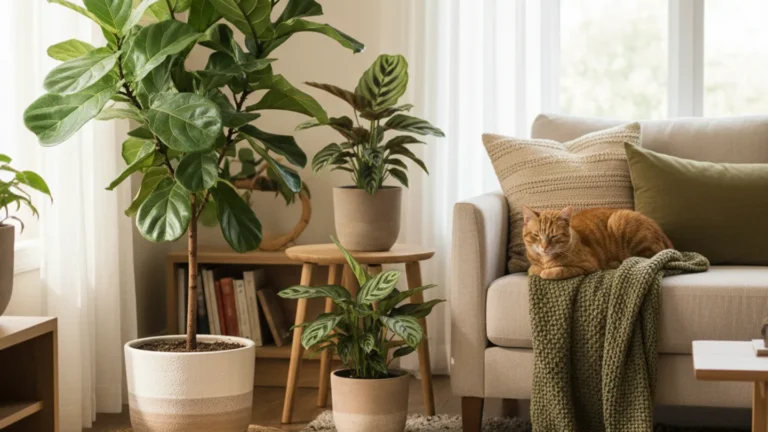
The best match is a prayer plant, specifically a large Calathea or Maranta variety. These are generally considered non-toxic to cats and dogs, and they give you bold, patterned foliage that fills a corner the same way a monstera does. They like bright, indirect light, similar to what a monstera wants, so your spot on the windowsill still works.
If you want height instead of width, a parlor palm is another generally considered non-toxic option with a lush, tropical shape. Both swaps let you keep the vibe and drop the worry. Want more ideas? Browse our blog for pet-safe picks by light level.
Common questions about monstera and pets
Is monstera toxic to cats?
Yes. Monstera is toxic to cats because of insoluble calcium oxalate crystals. A bite causes mouth pain, drooling and pawing at the face. Most cats recover within a day, but call a vet if swelling or breathing problems appear.
Is monstera toxic to dogs?
Yes, for the same reason. Dogs that chew monstera leaves get mouth and throat irritation from the crystals. Symptoms are usually mild and short-lived, but heavy swelling is a reason to call your vet.
Are some monstera varieties safer than others?
No. Monstera deliciosa, Monstera adansonii and other monstera species all contain calcium oxalate crystals. Treat every monstera as toxic to cats and dogs.
What is a pet-safe plant that looks like a monstera?
A large Calathea or Maranta gives you bold tropical foliage and is generally considered non-toxic to cats and dogs. A parlor palm works well if you want height.
My cat only licked a monstera leaf. Is that dangerous?
A quick lick usually causes little to no reaction, since the crystals release when tissue is bitten or crushed. Watch for drooling or mouth discomfort for a couple of hours, and call a vet if symptoms show up.